
October, our wild, windswept and interesting month in any calendar of timing. Not only does it bring autumn, it brings a plethora of colours, winds that dance with nature, and the beginning of ‘new beer brewing season’ in certain countries. If that isn’t enough for you, there are spooky vibes for the children alongside the most powerful time of year to honour our ancestors. This month gives us time dedicated to the realm beyond what we see.
October begins with a strong reminder from nature that this is the best time to let go of what no longer nourishes us. That also means looking at what we might reduce or remove: the actions or thoughts that diminish our light and our truth.
Settling Vata
From an Ayurvedic perspective, October is definitely a month when Vata is heightened. (Vata is the dosha of air and space, the energy of movement and change.) Balance is best restored with a gentle 10 to 20 minute yoga practice in the morning. This helps our digestion, removes toxins from the joints and, most of all, helps us breathe better very quickly.
Vata loves food and activities that are grounding and gently warming, in both spice and temperature. Cosy comfort in all things helps Vata thrive through the transitions of autumn, allowing its natural spark of creativity to feel supported and nourished.
To stabilise Vata quickly, we only need to bring our focus back to ourselves and the present moment. Vata tends to look beyond its own body; it seeks information fast and moves rapidly towards it like a gazelle. When we turn our curiosity inward, self-observation keeps the mind steady.
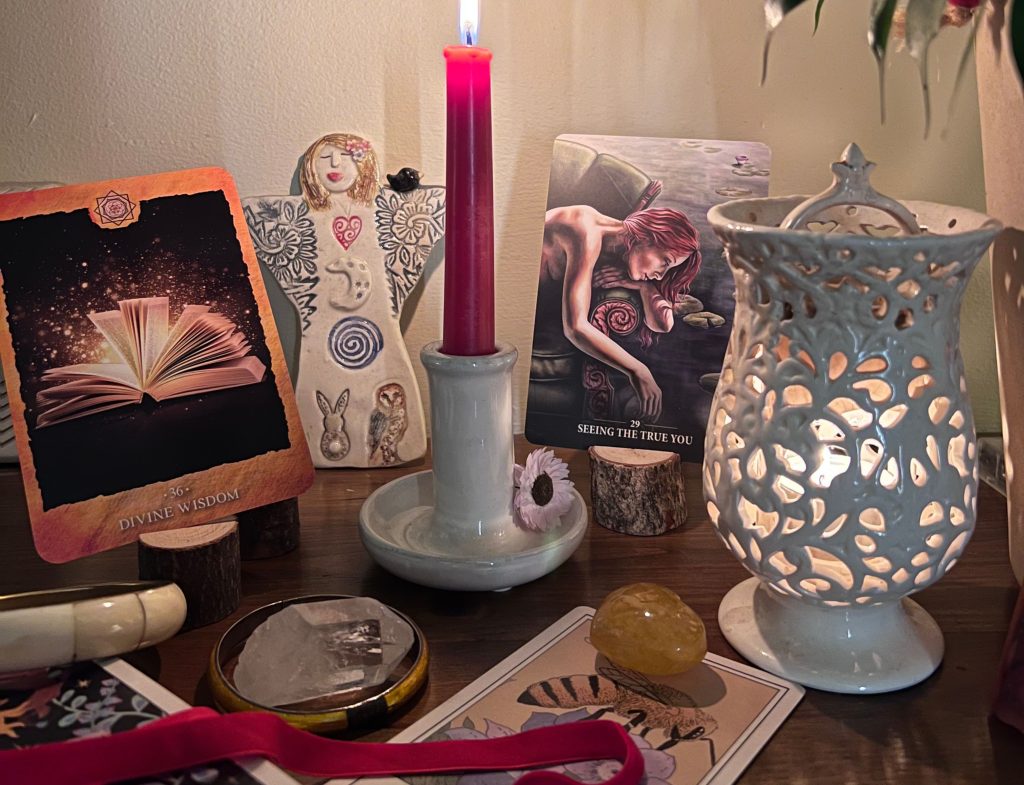
This is where an altar comes in. By creating one, we pull our own curiosity back to the present. Altars are a very personal addition to your daily life or spiritual practice, and certainly not necessary. An altar is a visual and sensory reminder of what you choose to cultivate and honour, and not something everyone will use.
The ritual in the everyday
For many of us, ritual is already woven into our lives. We meet the seasonal transitions with changes in our household: lighting a fire in autumn, hanging clothes on the line in spring. But let’s not forget that our daily habits are forms of ritual too. They may seem perfunctory, but they are conscious acts that sustain a life-enhancing rhythm: our daily ablutions, the appreciation of cooking food or offering kudos for food served, how we set up our place of work, how we travel to and from places. These are all moments of intention. They may need a little more awareness to become truly intentional, but daily life is like that; it ebbs and flows. The more present we are to the intention, the clearer the moment becomes, and we see life arrive.
I have always enjoyed making altars around my house; they are smattered in a few small spaces. Anyone who visits will see a candle, a picture, a leaf or a flower, and sometimes respond kindly, ‘Aww, that’s a lovely picture.’ For me, this space on this table, my mantel, under that lamp, is a precious moment of remembrance, a chance for my heart to pause and breathe. I have finally come to realise I have a great desire to remain connected to more than what I see.
I have learned that it is in the mundane where the most sacred moments arrive.
That is ritual.
Creating your own altar
An altar is a place to honour whatever you wish to draw your attention to. The reasons are endless, but some things spark us into action: a change of season in your life or outdoors, an intention for something you’d like to unfold, a prayer, or simply a way of bringing greater presence into your everyday life.
Creating and tending your altar can become a meaningful part of everyday life. That doesn’t mean you see it every day, but somewhere in your psyche you know it is there, ready for you to come back to.
There is no right or wrong way to create an altar. Let it unfold naturally; as you begin to trust your own intuition, the space will evolve in its own time.
A good start is to light a candle for a special intention in a specific place, and sit for a moment to be present. This can become a habit of stillness, or at least a moment to ‘not do’. Over time you might find yourself bringing things to this space, like gifts of honour and respect: a little book, reflections on your day, a pebble from the shore, a flower, a photograph, a handwritten quote, an oracle card or a picture. Let your own kind nature be your guide. All the same, you only need to arrive to honour the past and present, and here we meet our future and can, at last, be still.
An altar is not something you create once. It has the potential to be a living expression of who you are becoming.
Watch my Altar to Autumn video…it’s a bit of a meander.
Who are you becoming?
I wrote the quote above three days ago, and today this is the mantra card I pulled for my yoga group: a chant that strongly beckons us back to our own latent potential.
Adi Shakti, Adi Shakti, Namo Namo.
‘I bow to the Life energy, to what encompasses both power and energy, to the creative divine energy, to the Kundalini mata shakti, mata shakti, namo namo.’
(Translation by Lili Barbery-Coulon)
Nirinjan Kaur teaches the Adi Shakti Meditation.
Also this month: watch me make Crab Apple dal! It was one of the biggest eating surprises ever!
If you’d like to join The Dosha Life Facebook group, join here.
Go gently,
Kelly
